How do you get better answers from ChatGPT and Claude?
By Capital Growth Studio · Published · 6 min read
Give it what you'd give a new hire. Then check every number.
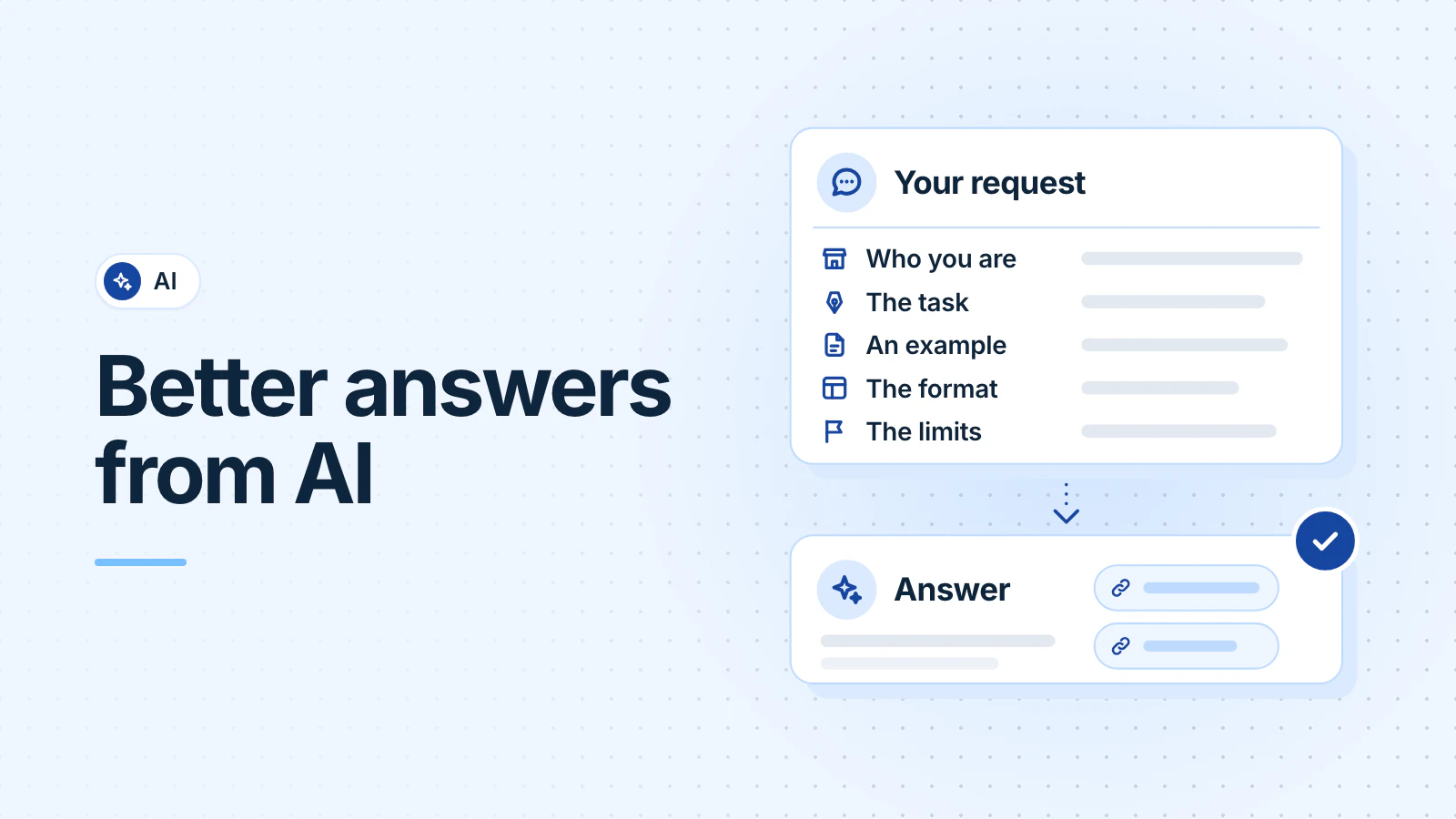
Give ChatGPT or Claude what you'd give a new hire: who you are, the task, an example, the format and the limits. Both companies' own guides say so. Then keep your business facts in a Project, ask the tool to work from your own files, and check every number before you use the answer.
What should a request to ChatGPT or Claude include?
OpenAI and Anthropic give the same advice in different words. OpenAI lists the goal, the context, the output and the boundaries (OpenAI ChatGPT Learn, October 2026). Anthropic's Claude 101 course says to set the stage, define the task and specify rules, with examples (Anthropic Academy, October 2026). Its help center calls Claude "a newly-hired contractor" with no context "about you, your task, or your organization" (Claude Help Center, March 2026).
So a good request has five parts:
- Who you are: your trade, your area and who will read the result.
- The task: one job, such as a reply, a summary or a checklist.
- An example: an email or quote you liked, to match its tone and layout.
- The format: the length and layout, such as "under 120 words, no bullet points."
- The limits: what must not change, and what to flag instead of guessing.
OpenAI says "a short prompt is often enough," so use only the parts that help. If the answer misses, ask for one specific change. New to both tools? Start with our first-week plan for ChatGPT and Claude.
Why put your business facts in a Project?
So you stop retyping them. OpenAI says projects "keep related chats, files, and instructions together" (OpenAI Help Center, October 2026). Anthropic says to make one "when you keep re-uploading the same files or re-explaining the same rules" (Anthropic Academy, October 2026). Free Claude accounts can create up to five projects (Claude Help Center, October 2026).
Add what rarely changes: your services, service area, hours, warranty terms, tone and the questions customers ask. Then add a few lines of instructions, like this sample from OpenAI's small-business workshop: "Use only the supplied offer details. Flag missing information. Keep every customer-facing output as a draft for owner review." Keep "passwords, payment details, confidential records, and other secrets out," the same page says (OpenAI Academy, August 2026). Our staff AI policy guide covers the rest.
Mosby Building Arts, a 135-person remodeling company, works this way. In his own article for Pro Remodeler, owner Mark McClanahan describes a 30-page document in a custom Claude project that tells Claude how to behave, including "be 90% confident or ask follow-up questions." His first rule for managers: "You're responsible for the output" (Pro Remodeler, August 2026).
How do you get answers from your own files?
Ask from your documents, not from the tool's memory. Upload the price sheet, manual or spec, and say "use only the attached file." Two limits matter:
- Spreadsheets: OpenAI asks for "clear column names and one record per row." It warns that ChatGPT "may not reliably extract exact values" from scanned files, so send the spreadsheet itself (OpenAI Help Center, October 2026).
- Word files: Claude reads only their text, not pictures placed inside them (Claude Help Center, July 2026).
Intrepid Electronic Systems, a fire alarm and electrical contractor in Crockett, California, built an AI system on hundreds of manufacturers' fire alarm manuals. Field technicians query it by phone, and each answer links to where the data came from, so they can check it. The trade magazine Electrical Contractor called this "a step that most companies using A.I. overlook" (Electrical Contractor, February 2026).
How do you check what the AI tells you?
Treat every number, date and name as unchecked. Anthropic says made-up answers are most likely with "exact details like dates, names, or numbers" (Anthropic Academy, October 2026). Its tips, plus OpenAI's:
- Ask for sources. Then open them and confirm they support the answer.
- Say up front: "It's ok if you don't know."
- Recalculate the numbers that matter. OpenAI's workshop says: "A polished answer is still a draft to evaluate."
- For important work, ask a new chat to find errors in the answer.
- Check names, dates, prices and promises against your records before anything reaches a customer.
A construction office worker on Reddit who uses Claude for emails and spec reviews put it this way: "Anything made by ai is verified and gone through with a comb" (r/Construction, August 2026). For website text, see whether Google penalizes AI content.
Should you ask the AI to ask you questions first?
Yes, for any job bigger than a quick reply, because its questions show what you forgot. OpenAI's workshop uses this request: "First ask up to three questions that would materially improve the result. Then rewrite the prompt using Goal, Context, Output, and one important Boundary." Anthropic's version: "Ask me questions about what I'm trying to do, then write me a better prompt."
How do you save the requests that work?
When a request works twice, save it:
- A Project holds the files and instructions for one area of work, such as estimates.
- A Skill is a saved method for a job you do the same way each time. ChatGPT offers Skills on eligible Business, Enterprise, Healthcare and Edu plans (OpenAI Help Center, October 2026). Claude offers them on paid plans, with code execution turned on (Claude Help Center, October 2026).
Don't build a custom GPT. OpenAI plans to retire them: Enterprise workspaces on December 11, 2026, with other plans expected to follow. Personal accounts already can't create new ones (OpenAI Help Center, checked October 13, 2026).
What do weak and better requests look like?
These requests are our own examples of the pattern, not prompts the businesses published.
| Business | Weak request | Better request |
|---|---|---|
| Mosby Building Arts (Claude Project) | "Write our staff newsletter." | In the Project: "Draft this month's 300-word staff newsletter about our scope-of-work reviewer. Informal tone, numbered lists. If you're unsure of a fact, ask me." |
| Intrepid Electronic Systems (answers with sources) | "How do I wire this module?" | "Using only the attached manual, list the wiring steps for this module, with the page number for each step. If the manual doesn't cover it, say so." |
| A made-up example: a med spa in Bethesda | "Write FAQs about lip filler." | In a Project with the treatment menu and aftercare sheet, but no client records: "Draft answers to the eight questions new clients ask most about lip filler. Use only these files. Under 60 words each. Mark any answer our medical director should review." |
At the med spa, a licensed clinician checks every treatment claim before it's published. Client names, photos and health details stay out of the chat.
Frequently asked questions
Should I build a custom GPT for my business?
No. OpenAI plans to retire custom GPTs, and personal ChatGPT accounts can no longer create new ones. Keep your instructions and files in a Project instead.
How long should a prompt be?
As long as the job needs. OpenAI says a short prompt is often enough, and bigger tasks need the goal, context, output and limits. Start short, then add detail where the answer misses.
Updated .