Is pay-if-paid legal in Virginia? Subcontractor Payment Guide for Virginia, Maryland and DC
By Capital Growth Studio · Published · 5 min read
This article explains pay-if-paid clauses and the payment rules for subcontractors in Virginia, Maryland and DC. It also shows how to track each payment that is due to you.
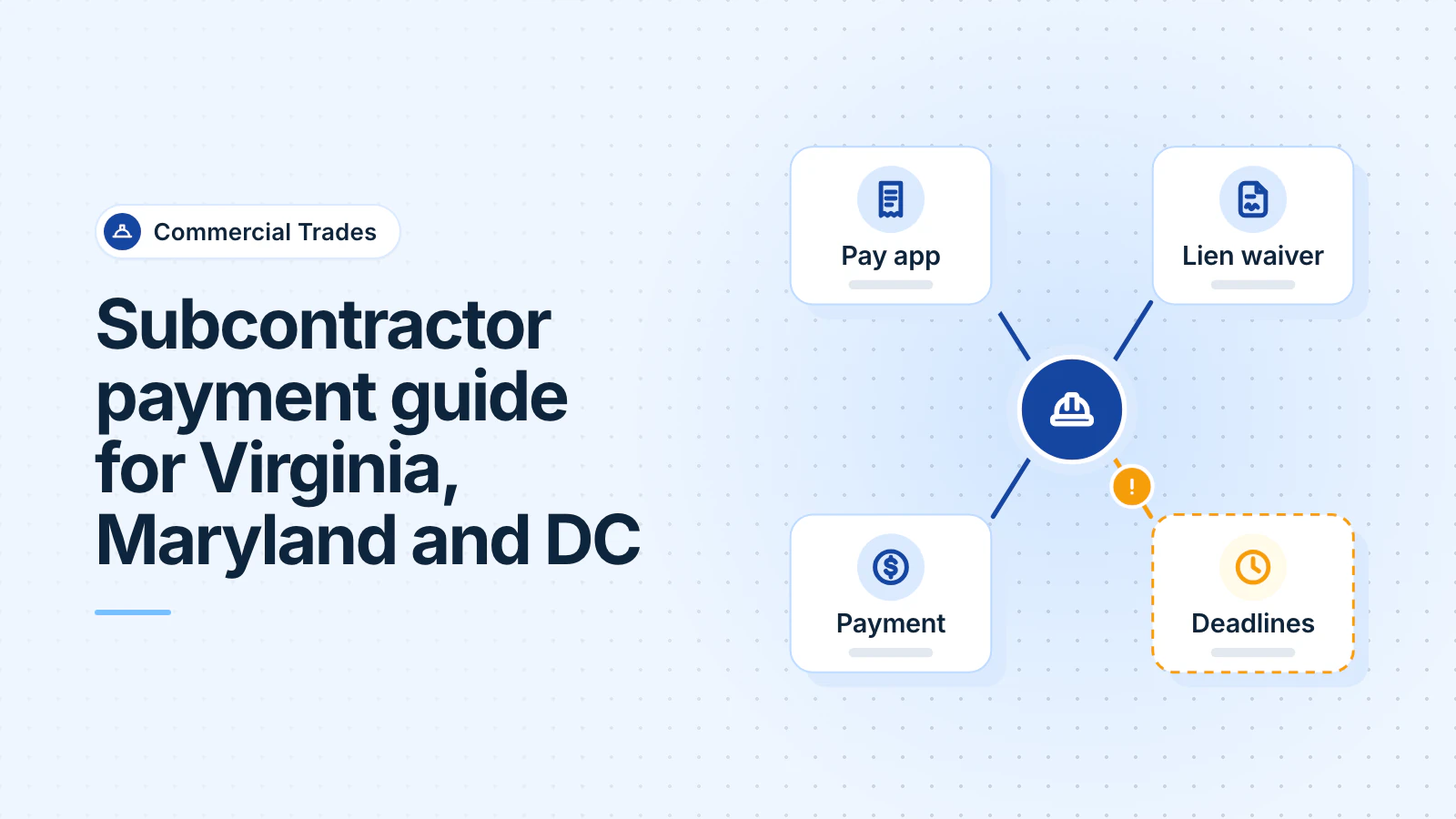
A pay-if-paid clause makes the owner's payment to the general contractor (GC) "a condition precedent" to paying the subcontractor. A condition precedent is an event that must happen before a duty starts. A pay-when-paid clause relates to timing. It lets the GC delay payment until the owner pays, "but not indefinitely" (PilieroMazza, May 2024).
As of October 2026, Code of Virginia § 11-4.6 makes pay-if-paid clauses unenforceable. It sets payment within 60 days after the invoice or 7 days after the GC is paid, whichever is earlier. Maryland and DC law set 7 days after the GC is paid, for undisputed amounts.
Laws change, so check the current rules before you act (links at the end of this article).
Want help with tracking your payments? Apply for a free consultation
What do Virginia, Maryland and DC say?
As of October 2026, the laws compare as follows:
| Rule | Virginia | Maryland | DC |
|---|---|---|---|
| GC pays the subcontractor | Earlier of 60 days after the invoice or 7 days after the GC is paid | Undisputed amounts within 7 days after the GC is paid | Undisputed amounts within 7 days after the GC is paid, at every tier |
| Pay-if-paid clause | Unenforceable, unless the paying party is insolvent or bankrupt | Cannot waive lien or bond rights (§ 9-113) | Cannot waive lien or bond rights (§ 27A-104) |
Virginia's pay-if-paid rule applies to private construction contracts executed on or after January 1, 2023 (2022 Acts, Chapter 727). Under § 11-4.6, a GC that withholds payment gives written notice within 50 days of receiving the invoice.
Amendments. The General Assembly amended § 11-4.6 again in 2023 and 2026. So the wording that applies can depend on the contract date.
Lien and bond rights are the rights to claim a mechanics' lien and to sue on a contractor's bond.
Why do subcontractors still wait for payment?
A pay application is your bill to the GC for work done. Billd sells financing to subcontractors. In its June 2026 national survey, respondents reported waiting 51 days on average for payment after a pay application.
Other delays start in your own office:
- Missing lien waivers. A lien waiver is a signed release of lien rights for a payment. A missing waiver can delay that payment.
- Late or wrong pay applications. A pay application with an error can go back for correction.
- No record of dates. Without dates, it is hard to see which payment is late.
What does a payment tracker do?
A payment tracker is one record of billing and payments for each job. It shows:
- each pay application, with the date the GC received it and the amount billed
- each payment received, with its date and amount
- each open lien waiver and each withholding notice from the GC
With one record, your office sees which payments are open and for how long. Staff can then contact the GC with exact dates and amounts.
Should you use a spreadsheet or a custom tool?
| Option | Pros | Cons |
|---|---|---|
| A spreadsheet | Low cost and easy to start | Dates entered by hand, and no reminders |
| Your accounting software's aging report | Shows unpaid invoices by age | Does not list lien waivers |
| Separate billing software | Made for subcontractor billing | One more system for staff to learn |
| A custom tool on your own software | Fits your process, and you own it | Needs a setup project |
Where can you check the current rules?
Laws and regulations change, and amendments, court decisions or agency guidance can change how a rule applies. We checked the sources in this article on October 20, 2026. Before you act, read the current official text for each place where you work:
- Maryland: Maryland Code, Real Property § 9-302 (Maryland General Assembly)
- Virginia: Code of Virginia § 11-4.6 (Virginia Law Library)
- District of Columbia: D.C. Code § 27A-104 (D.C. Law Library)
If your business works in any other state, we strongly recommend that you check that state's current law and its latest amendments, because they may change how these rules apply to you.
Capital Growth Studio is not a law firm. This article is general information, not legal advice. For advice on your situation, speak with a licensed attorney.
Frequently asked questions
Is Virginia a pay-when-paid state?
As of October 2026, Code of Virginia § 11-4.6 does not use that term. Under it, owner payment is not a condition precedent to paying the subcontractor.
Does Maryland limit retainage?
As of October 2026, Maryland Real Property § 9-304 limits retainage, the money held back to guarantee performance. The limit is 5% when the contractor has furnished 100% performance and payment security. A contractor may not hold back a higher percentage from a subcontractor than the owner does. The section does not apply to contracts under $100,000, and it lists other exceptions.
Updated .
Sources: PilieroMazza via NASBP (May 2024); Virginia Acts of Assembly 2022 Chapter 727, 2023 Chapter 675 and 2026 Chapter 1040; Maryland Real Property § 9-113 and § 9-304; Billd subcontractor market report (June 2026).