What should a capability statement for an MEP contractor include?
By Capital Growth Studio · Published · 6 min read
One page: what you do, what you've built, and the codes and certifications a buyer needs.
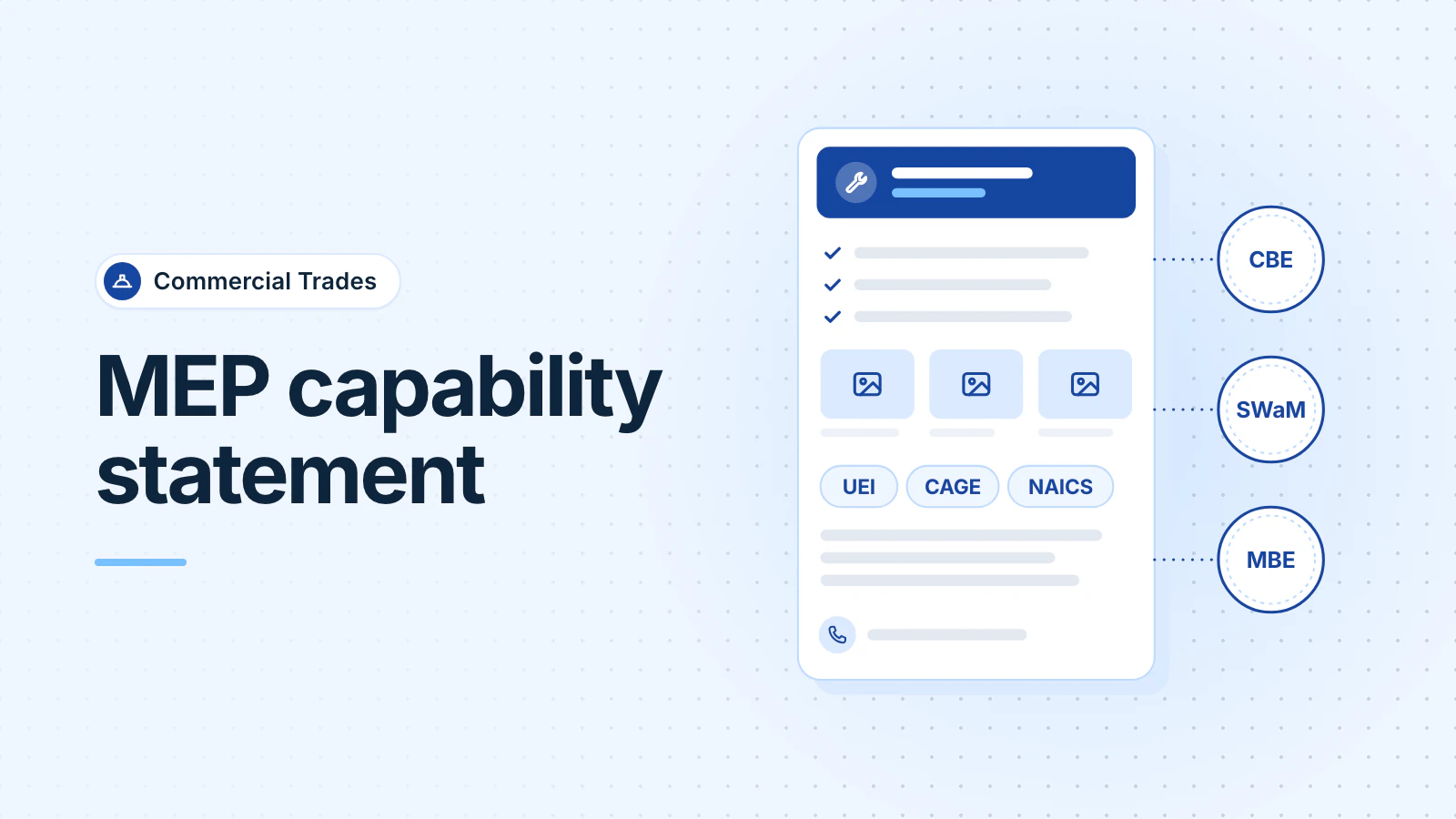
A capability statement is a one-page summary of your firm for buyers. For an MEP contractor, list your core competencies first, then past performance, differentiators and company data: UEI, CAGE code, NAICS codes, licenses, bonding and insurance. Then add certifications such as DC CBE, Virginia SWaM or Maryland MBE.
What is a capability statement, and who asks for one?
It's a short marketing document for public and institutional work. The SBA calls it "a one-pager (front and back is acceptable) for an initial meet and greet" (SBA capabilities statement guide, checked October 2026). HHS gives the same advice: one page, front and back, with bullets and simple tables (HHS, reviewed July 2024).
MEP firms send it to public agencies, prime contractors, institutional owners and property managers, often with a vendor application or an introduction email.
What goes on it, and in what order?
The SBA guide names five core elements: core competencies, differentiators, past performance, corporate data and contact information. For an MEP contractor, this order works well:
- Core competencies: the work you do best, in the words an owner uses in a scope.
- Past performance: your most recent and most relevant projects.
- Differentiators: facts a competitor can't simply claim.
- Company data: IDs, codes, licenses, bonding, safety and insurance.
- Certifications: each one with its number and the codes it covers.
- Contact: one named person, with a direct phone number and email.
How do you write core competencies and differentiators?
Name the work the way an owner writes it in a scope. "HVAC services" says little. "Chiller and boiler replacement in occupied buildings" or "24/7 service for commercial plumbing" tells a buyer where you fit.
Differentiators need proof. Strong ones for MEP firms include:
- 24/7 service with your own technicians.
- In-house prefabrication or BIM coordination (shared 3D models of the building systems).
- Experience in occupied hospitals, labs or schools.
- Credentials your technicians hold, such as EPA Section 608 certification for refrigerant work, or NICET certification for fire alarm or sprinkler layout work.
Leave out words any firm could use, such as "quality" or "integrity".
How do you list past performance when projects are under NDA?
The SBA notes that "past performance as a subcontractor can be more relevant than prime past performance in some cases." That suits MEP firms, which often work under a general contractor. For each project, give the building type, location, your scope, your role and the year.
If a contract or NDA bars naming the owner, describe the job without the name. A made-up example: "Mechanical subcontractor, lab renovation in an occupied building, Montgomery County, MD, 2025: chillers, air handlers and controls." Ask clients in writing before you use their names, logos or photos.
What company data should an MEP contractor list?
| Item | What to list |
|---|---|
| UEI | The Unique Entity ID that SAM.gov assigns when you register. You can also request the ID alone (SAM.gov). Both are free (SAM.gov checklist). |
| CAGE code | If you don't have one, it's assigned after you submit your SAM.gov registration (SAM.gov checklist). |
| NAICS codes | For example, 238220 Plumbing, Heating, and Air-Conditioning Contractors, which also covers fire sprinkler installation (Census Bureau), and 238210 Electrical Contractors and Other Wiring Installation Contractors (Census Bureau). |
| Licenses | The license number, trade and class for each jurisdiction you work in. |
| Bonding | Single-project and aggregate capacity, and your surety, if you choose to share them. |
| Safety | Your EMR (experience modification rate, a workers' compensation rating) with its year, if you choose to share it. |
| Insurance | Coverage types and limits. |
| Service area | The counties and cities you serve, and whether you offer 24/7 service. |
A SAM.gov registration must be renewed every 365 days (SAM.gov). The SBA guide also says to keep your SAM profile in sync with your capability statement.
Which DC, Maryland and Virginia certifications belong on it?
List each certification you hold, with its number, expiry date and the NAICS codes it covers. The three main local programs differ:
| Program | Who certifies | Key facts |
|---|---|---|
| DC CBE (Certified Business Enterprise) | DC Department of Small and Local Business Development (DSLBD) | Gives preference on DC government contracts. The firm's principal office must be in DC (DSLBD). Certification lasts three years, and DSLBD doesn't accept other jurisdictions' certifications (DSLBD FAQ). |
| Virginia SWaM (Small, Women-owned and Minority-owned) | Virginia Department of Small Business and Supplier Diversity (SBSD) | For state-funded projects, and many localities use it too. "Small" means at least 51% owned by U.S. citizens or legal resident aliens, with 250 or fewer employees or average annual gross receipts of $10 million or less over three years (SBSD). |
| Maryland MBE (Minority Business Enterprise) | Office of Minority Business Enterprise, part of the Maryland Department of Social and Economic Mobility (DoSEM) since October 1, 2025 (DoSEM) | Counts toward minority participation goals on state-funded contracts and on contracts from most Maryland counties and cities. Your approval letter lists the NAICS codes you're certified for (MBE overview, 2026). |
Maryland's MBE pages still sit on the Maryland Department of Transportation (MDOT) website. If you hold federal certifications, such as 8(a) or HUBZone, list them in the same block. Certification rules change, and we checked these agency pages in October 2026. This is general information, not legal advice.
How do you keep it current?
Keep one project list and build the statement from it. Each time you finish a job, add the scope, photos and the client's permission to name them. Then update the statement, your project sheets and your website from that list. Also track the renewal dates: SAM.gov every 365 days, DC CBE every three years, and Maryland's yearly Declaration of Eligibility on your certification anniversary (DoSEM).
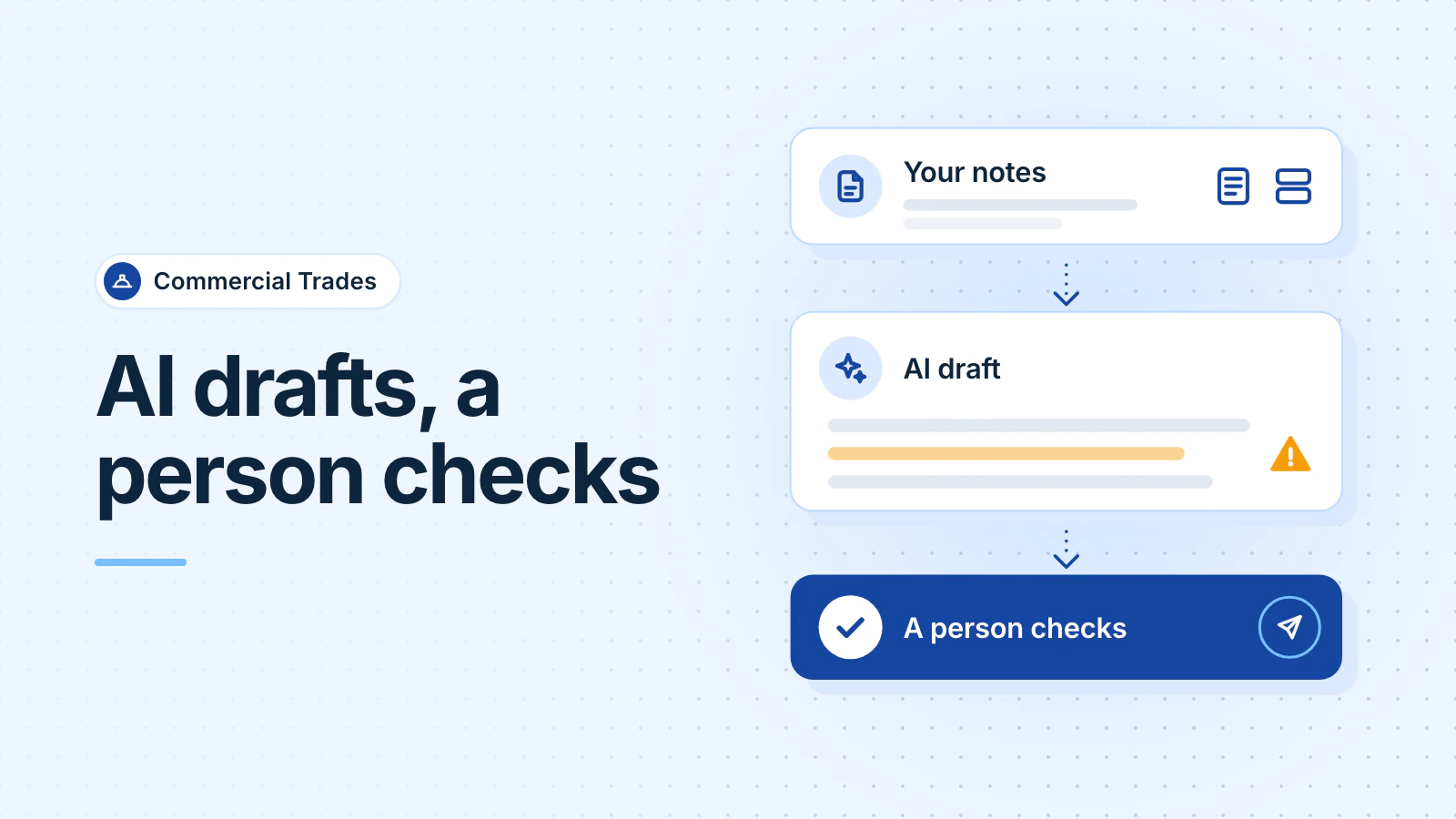
Our Project Proof Kit sets this up: one project list that feeds your capability statement, project sheets and website. An AI tool can draft the first version from that list, as our guide to AI for trade office paperwork explains, but a person checks every fact.
Frequently asked questions
Do I need a SAM.gov registration to have a capability statement?
No. A capability statement is your own document. But to bid on federal contracts as a prime contractor, you need an active SAM.gov registration, which also gives you your UEI. Both are free. If you don't bid federal work, list the IDs and certifications you do have.
Is a capability statement the same as a prequalification form?
No. A capability statement is your one-page summary, in your words. A prequalification form is the buyer's questionnaire, and it usually asks for more, such as financial statements, safety records, insurance certificates and references. Fill in both from the same project list and company facts, so the details match.
Should I make a different version for each buyer?
Yes, when the work differs. The SBA guide says you can have multiple versions for different audiences. Keep the company data the same, and change the competencies and projects to fit the buyer, such as a hospital owner or a property manager.
Updated .