Can a med spa advertise Botox on Google, Facebook and Instagram?
By Capital Growth Studio · Published · 6 min read
Google, Meta and your state board each set their own rules. Here's what each one allows.
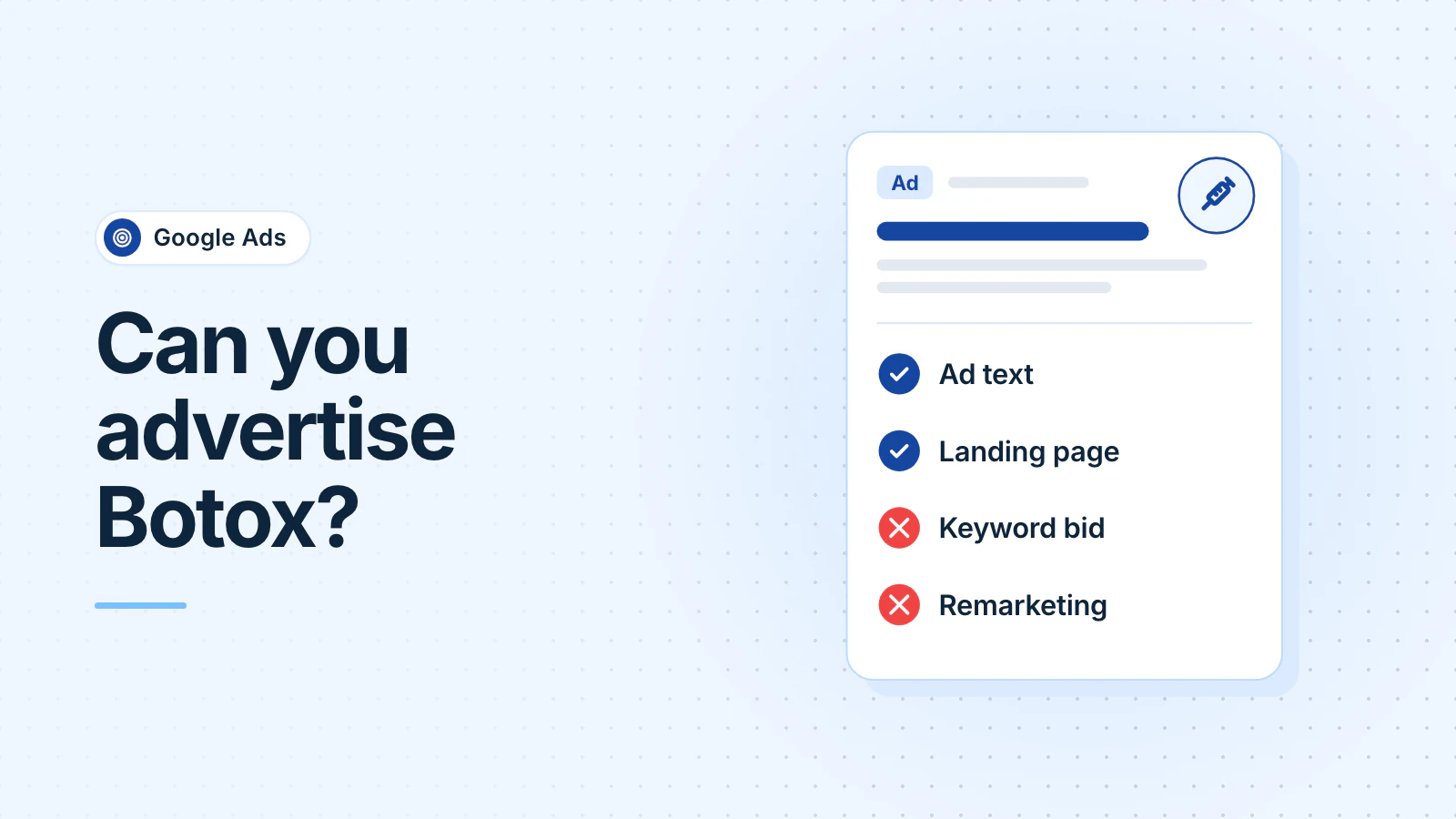
Yes, with limits. On Google, a US med spa can name Botox in its ads and landing pages without certification, but it can't bid on "Botox" as a keyword or use remarketing lists. Facebook and Instagram allow injectable ads aimed at adults 18 and over. State boards in DC, Maryland and Virginia ban misleading claims.
We checked each policy below on October 13, 2026. This is general information, not legal advice.
What does Google allow in a Botox ad?
Google treats Botox as a prescription drug term. Its list of monitored drugs includes "botox", "botulinum toxin", "dysport" and "xeomin" (Google Ads prescription drug list, October 2026). For US campaigns, the rule is: "While you don't need to be certified in order to use prescription drug terms in ads and landing pages, you must be certified in order to keyword-target these terms" (Google Ads Help, October 2026).
| What you want to do | Allowed without certification? |
|---|---|
| Name Botox, Dysport or Xeomin in the ad text | Yes |
| Name them on your landing page | Yes |
| Bid on "botox" or "botox near me" as keywords | No |
| Use remarketing lists or upload a client list | No, for any injectable ad (see below) |
| Use Google's own audiences, such as in-market | Yes |
Certification is for set business types, "for example, Online Pharmacy, Addiction Services, Telemedicine, Health Insurance, or Pharmaceutical manufacturer". Google says: "Do not apply for a category that does not match your business model." None of those is an in-person med spa. So build keywords around the treatment and the town, such as "wrinkle treatment Arlington", and name the product in the ad where it's accurate. Our Google Ads service can set this up for you.
Can you use remarketing for injectables?
No. Google lists "Invasive medical procedures, including cosmetic surgery, surgical procedures, or injections" as a sensitive health category. Those ads "can't use advertiser-curated audiences", such as Customer Match, your data segments and lookalike segments (Google personalized advertising policy, October 2026). Google's own audiences, such as in-market, and location targeting are still allowed. So don't upload client lists or build website-visitor lists for injectable campaigns.
What does Meta allow on Facebook and Instagram?
Meta's Health and Wellness standard covers cosmetic procedure ads (Meta Advertising Standards, October 2026):
- Age: ads for "cosmetic products, procedures or surgeries" must target people 18 or older, and Meta lists "injectable treatments" among them.
- Before-and-after photos: allowed when the ad targets adults.
- Wording: no "statements of inferiority about physical appearance". Avoid a headline such as "Embarrassed by your frown lines?"
- Promises: no "promises of specific outcomes within a set timeframe without disclaimers or qualifiers".
Promoting the drug itself is stricter. Meta lets online pharmacies and telehealth providers with LegitScript certification, and drug makers, promote prescription drugs once Meta authorizes them (Meta Advertising Standards, October 2026). Meta doesn't say when an ad for a Botox appointment counts as promoting the drug. So lead with the treatment and the consultation, and keep brand names out of headlines. To see how Meta ads compare with Google search ads, read Google Ads vs. Facebook Ads.
Why can't Meta track bookings from your ads?
Meta may put your website in a "Health and wellness" data category, which covers "provider/patient relationships" and "health-related products and services" (Meta Business Help Center, October 2026). Then it may apply one or more limits (Meta Business Help Center):
- Core setup: Meta stops receiving "custom parameters and parts of URLs following the domain".
- Event limits: Meta stops receiving "specific mid and lower funnel events", the ones closest to a sale.
- Full restrictions: no events at all, so Meta's tools "cannot be used for ads purposes" there.
Meta also bars sending information about "Medical procedures, treatments and testing", including in event names (Meta Business Help Center). To check your status, open Events Manager, then your dataset's Settings and "Manage data source categories". Count booked consultations in your own booking system, so you can judge Meta ads without Meta's conversion data.
What do DC, Maryland and Virginia rules say about ads?
Each one bans misleading ads, and the licensed provider answers for them:
| Where | What the rule says |
|---|---|
| Virginia (18VAC85-20-30) | "No licensee of the board shall advertise information that is false, misleading, or deceptive." A practice with several practitioners must record who is responsible for each ad. That record, and proof of any claim, must be kept for at least two years. |
| Maryland (COMAR 10.32.01.13) | A physician's ad can't include statements "intended to, or likely to, create false or unjustified expectations of favorable results". A stated fee must include related costs the patient will very likely need. No free or discounted offers when related charges follow within 72 hours of the first visit. |
| DC (D.C. Code § 3-1205.14) | No "misrepresentation or false promise, directly or indirectly, to influence, persuade, or induce patronage". No false or misleading statement about "the efficacy or value of a medicine, treatment, or remedy". |
Sources: Virginia Administrative Code, Code of Maryland Regulations and DC Code, all checked October 2026. Maryland's rule adds that a physician stays accountable when an agent places the ad. So have your medical director approve each ad, and keep the proof behind every claim. Our med spa page explains how we work with med spas.
Can you advertise Botox for the jaw, TMJ or shoulders?
Carefully. Botox Cosmetic is FDA-approved to temporarily improve frown lines between the brows, crow's feet, forehead lines and neck bands (FDA prescribing information, revised October 2024). Masseter (jaw), TMJ and trapezius (shoulder) treatments aren't on that list, so they're off-label uses.
The FDA says providers "generally may prescribe the drug for an unapproved use when they judge that it is medically appropriate for their patient". It also says the FDA "has not determined that the drug is safe and effective for the unapproved use" (FDA, October 2026). So in your ads:
- Describe the service by the treatment, such as "consultations for jaw muscle treatment".
- Don't call an off-label use "FDA-approved".
- Don't promise relief from TMJ pain, or any result you can't document.
Frequently asked questions
Do I need LegitScript certification to run Botox ads?
Usually not, for an in-person med spa. Google's US rules use LegitScript for online pharmacies, telemedicine providers and addiction services. Meta uses it for prescription drug ads from online pharmacies and telehealth providers. Without it, Google still lets you name Botox in ads and landing pages, but not bid on it as a keyword.
Can I advertise Botox prices or specials?
Yes, if the offer is clear and complete. In Maryland, a physician's ad can't state a fee that leaves out related costs a patient will very likely need. It also can't advertise free or discounted treatments when related charges follow within 72 hours of the first visit. Virginia and DC ban misleading ads, so say exactly what the price covers.
Updated .