Do your job posts need a pay range in DC, Maryland and Virginia?
By Capital Growth Studio · Published · 6 min read
Yes, in all three. Each law asks for something slightly different.
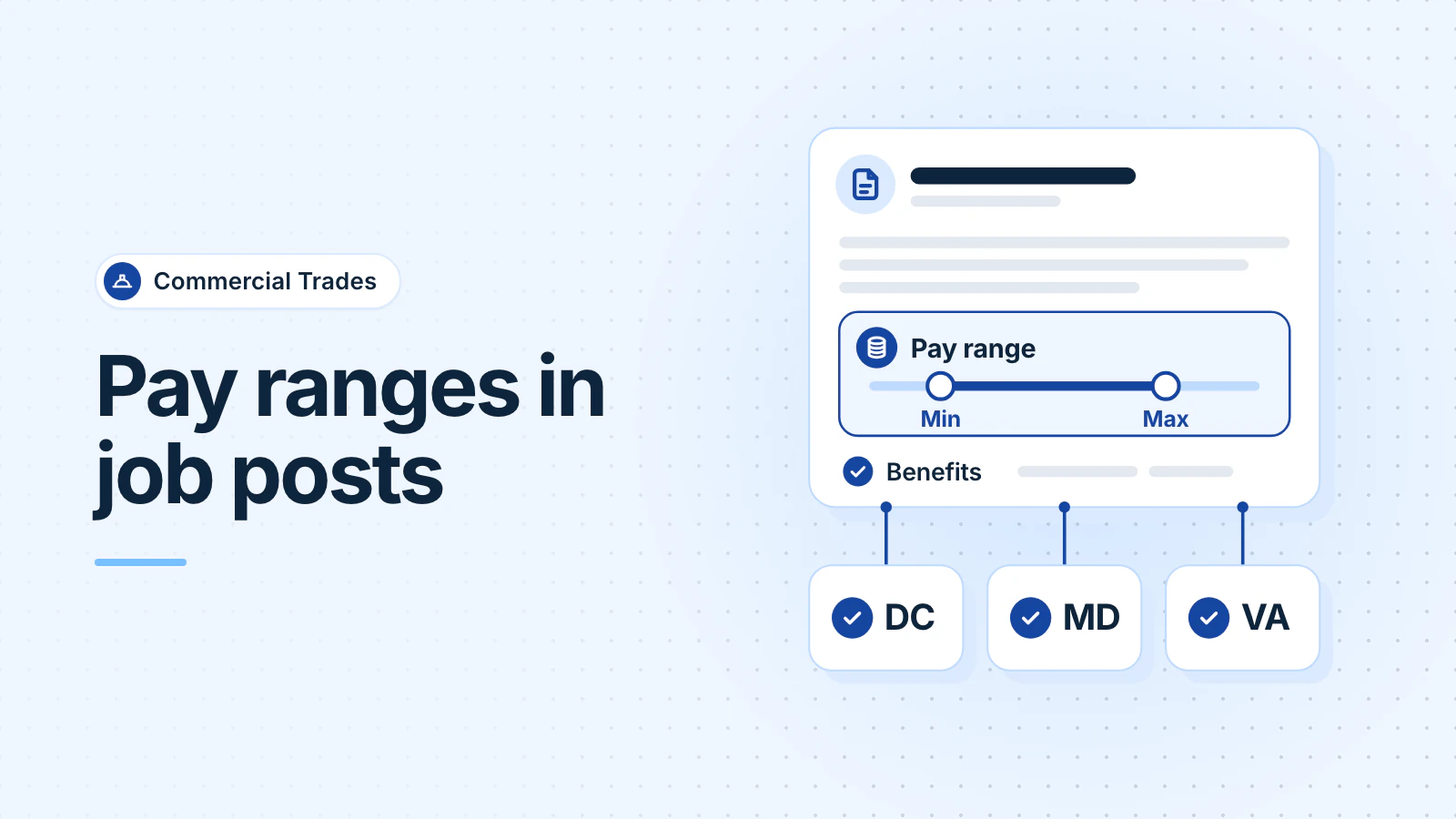
Yes. Virginia has required the pay or a pay range in every public and internal job posting since July 1, 2026. Maryland has required a range plus a general description of benefits and other pay since October 1, 2024. DC has required a minimum and maximum since June 30, 2024, and a healthcare benefits disclosure before the first interview.
None of the three sets a minimum company size. We checked each law on October 13, 2026. This is general information, not legal advice.
What does Virginia's pay transparency law require?
Virginia Code § 40.1-28.7:12 applies from July 1, 2026 (Virginia DOLI, July 2026). It covers any employer "doing business in or operating within this Commonwealth" (Code of Virginia § 40.1-2, October 2026). No employer may (Code of Virginia, October 2026):
- "Fail or refuse to disclose in each public and internal posting for each job, promotion, transfer, or other employment opportunity the wage, salary, or wage or salary range for the position."
- Set the range in bad faith. The test considers "the breadth of such wage or salary range."
- Seek an applicant's pay history, or rely on it to screen or set pay.
The Attorney General can seek up to $1,000 for a first violation and up to $5,000 for each later one. Applicants can sue within one year, but for a posting error you first get 15 business days after written notice to fix it.
What does Maryland's pay transparency law require?
Maryland's law covers any job "physically performed, at least in part, in the State." Each public or internal posting must show "the wage range and a general description of benefits and any other compensation offered for the position" (Maryland Code § 3-304.2, October 2026). The state labor department's FAQ adds (Maryland Department of Labor, October 2026):
- Other pay includes overtime, differentials, bonuses and commissions.
- A fixed rate is acceptable: "$30 an hour" is allowed, but "$30+ an hour" is not.
- Each location and seniority level needs its own range.
- Reposts are new posts. Keep a record of each post for at least 3 years.
- Posts on Indeed or LinkedIn, or by a recruiter for you, count.
- A "help wanted" sign on a truck is acceptable if a web address or QR code on it leads to the pay and benefits.
A first violation brings an order to comply. A second can cost up to $300 for each applicant or employee affected, and later ones within 3 years up to $600 each (Maryland Code § 3-308, October 2026).
What does DC's pay transparency law require?
DC's Wage Transparency Act covers any employer with at least one employee in the District (D.C. Code § 32-1451, October 2026). Since June 30, 2024 (D.C. Law 25-138), an employer must (D.C. Code § 32-1453.01):
- "Provide the minimum and maximum projected salary or hourly pay in all job listings and position descriptions advertised," set in good faith.
- "Disclose to prospective employees the existence of healthcare benefits that employees may receive before the first interview."
- Post a notice of these rights where employees gather (D.C. Code § 32-1453.02).
You may not screen applicants by wage history or ask former employers what they paid (D.C. Code § 32-1452). Fines are $1,000, then $5,000, then $20,000 for each later violation. The Attorney General enforces the law, and applicants can't sue under it (D.C. Code § 32-1455).
How do the three laws compare?
| Rule | Virginia | Maryland | DC |
|---|---|---|---|
| In force since | July 1, 2026 | October 1, 2024 | June 30, 2024 |
| Covers | Employers doing business in Virginia | Jobs done at least partly in Maryland | Employers with at least one DC employee |
| Pay in the post | A wage, salary or range | A range, or one fixed rate | A minimum and maximum |
| Benefits | Not required | Benefits and other pay, in the post | Healthcare benefits, before the first interview |
| Internal posts | Covered | Covered | Covered |
| Pay history | Can't ask | Can't ask | Can't ask or screen on it |
| Penalties | Up to $1,000, then $5,000; applicants can sue | An order, then up to $300 and $600 per person | $1,000, $5,000, then $20,000 |
What if you hire in more than one of the three?
Each law applies on its own, so a Rockville firm with DC jobs and Fairfax County service calls may need to meet all three. Maryland's law follows where the work is done, though occasional work there, such as a meeting, doesn't count. DC's Attorney General says its rules cover "all job postings soliciting employees in the District" (DC Office of the Attorney General, July 2025). Virginia's labor department says "all job postings and hiring advertisements in Virginia" need a range (Virginia DOLI, July 2026).
Use one standard for every post:
- A real minimum and maximum for each job, level and location. No "up to," "$30+" or "competitive pay."
- Benefits and other pay: health insurance, paid time off, retirement plan, overtime, on-call pay and bonuses. Naming health insurance in the post tells applicants before the first interview, as DC requires.
- No pay-history questions on your application form, in interviews or in recruiter scripts.
- The same standard for internal posts, promotions and transfers.
- A dated copy of each post, kept for at least 3 years.
How should a trade contractor write the pay line?
Start from your pay scale, what current staff in the role earn, or the job's budget. Virginia and Maryland name those as good-faith bases.
A made-up example: "Commercial HVAC Service Technician, Montgomery County, MD. $32 to $42 an hour, based on experience and certifications. Overtime and on-call pay. Health, dental and vision insurance, paid time off and a 401(k)."
For apprentices, journeymen and foremen, give each level its own range. If ChatGPT drafts your post, check that the range is in it.
Where does the range go online?
Everywhere the job appears: your careers page, each job board and the job data Google reads. Google's pay field, baseSalary, must match what the job page shows (Google Search Central, October 2026). Our guide to getting openings into Google's job search covers the rest. Our Hiring System for trade contractors builds one page per opening with the range, benefits and job data in place.
Frequently asked questions
Can I write "up to $40 an hour" or "competitive pay"?
Not safely. DC asks for a minimum and a maximum. Maryland accepts a range or one fixed rate, and its labor department says "$30+ an hour" is not allowed. Virginia accepts a single wage or a range, but "competitive pay" is neither.
Do internal promotions need a pay range?
If you post them, yes. All three laws cover internal postings for promotions and transfers. Maryland's labor department says a promotion that was never posted or advertised needs no posting.
Can I ask applicants what they earn now?
No. All three laws bar employers from seeking an applicant's pay history. If an applicant shares it unasked, Virginia and Maryland let you use it only to support a higher offer than your first one.
Updated .