Why does ChatGPT recommend my competitor, and is "AI SEO" worth paying for?
By Capital Growth Studio · Published · 6 min read
AI answers draw on your listings, reviews and website. Start there.
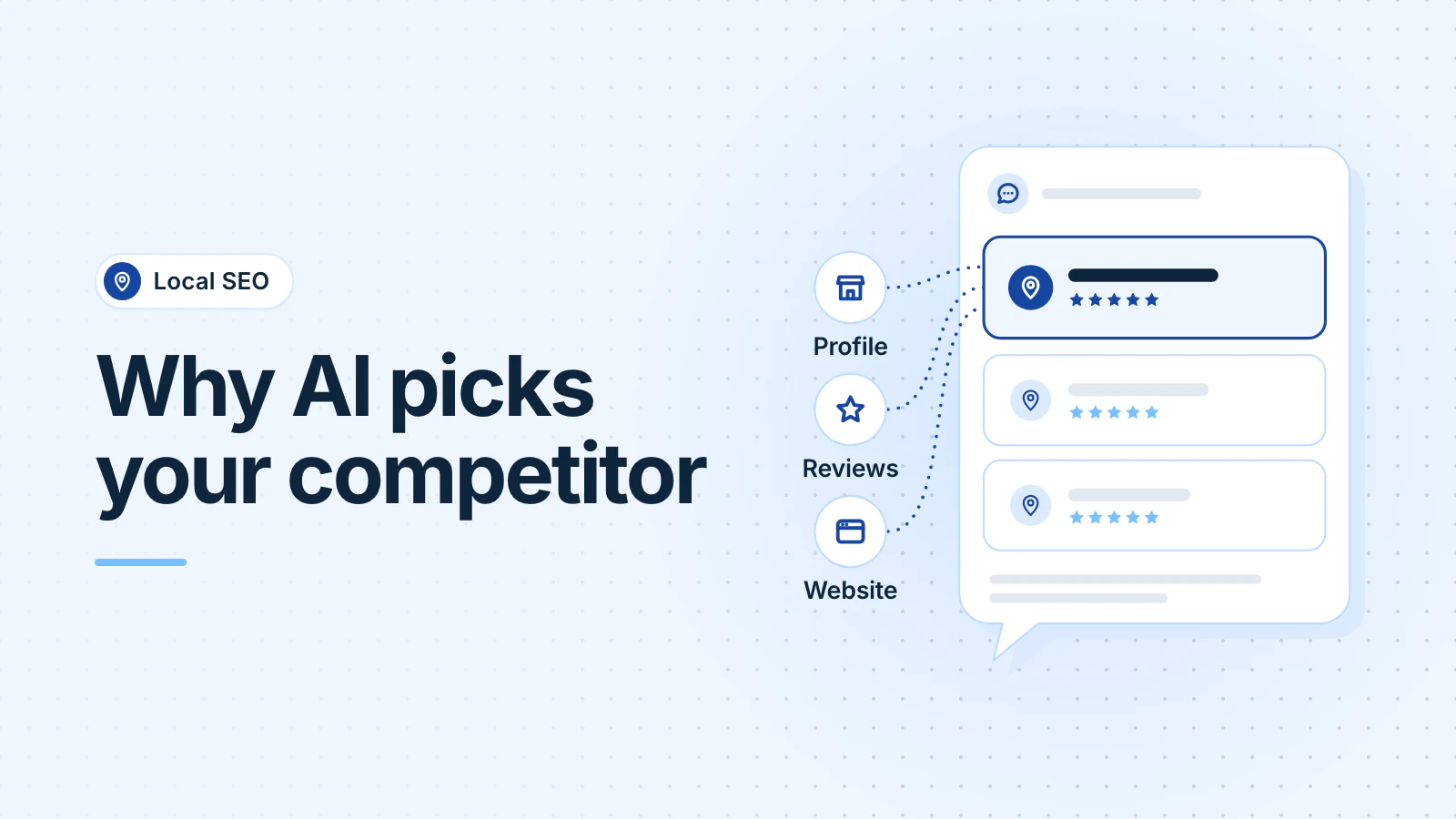
ChatGPT and Google's AI build local recommendations from the sources they can read: Google Business Profiles, Yelp, review sites and business websites. Their answers also change from one try to the next. So the fix is mostly the local SEO basics, and any "AI SEO" offer should show what it adds beyond them.
How do ChatGPT and Google's AI choose local businesses?
They search first, then summarize what they find. Neither company publishes a full list of ranking factors, but both describe the outline.
- Google: AI Overviews and AI Mode are "rooted in our core Search ranking and quality systems". They run several related searches, called query fan-out, to build an answer, and Google says a Business Profile can help your services show up in them (Google Search Central, July 2026).
- Google Maps: Ask Maps, which began rolling out in the US on March 12, 2026, draws on information about more than 300 million places, including reviews from over 500 million contributors (Google, March 2026).
- ChatGPT: OpenAI says ChatGPT search sometimes sends rewritten versions of your question to partner search providers, and it names Bing among them. It can also use your approximate location, based on your IP address (OpenAI Help Center). Yelp says its content partnership shows Yelp reviews, ratings, photos and business details inside ChatGPT (Yelp, August 2026).
So the tools lean on different sources. In BrightLocal's August 2026 analysis of nearly 2 million AI citations for local businesses, Google Business Profile was the top source for Google's AI features. For ChatGPT, Yelp was the top source, appearing in 80% of its local answers, and Google Business Profile wasn't among its top sources (BrightLocal). A competitor with a strong Yelp page can lead in ChatGPT while you lead in Google Maps.
Why does a competitor show up when your Google rankings are strong?
Because AI answers and the map are different systems, and AI answers change often. In BrightLocal's study of 200,000 local AI searches, published September 2026:
- Google Maps named a tracked business in 66% of searches. ChatGPT, AI Mode and AI Overviews named it in 32% to 38%.
- Running the same prompt again gave only 20% to 33% overlap in the businesses named. A business named once came back about half the time.
- ChatGPT shared only about 20% of its picks with Google's AI features.
- Searching from another part of the same town changed the results too.
SparkToro's January 2026 study found the same beyond local search: less than a 1 in 100 chance that ChatGPT or Google's AI gives the same list of brands twice (SparkToro). So one test, by you or a salesperson, proves very little.
Do the basics still matter for AI answers?
Yes. Google says there are "no additional requirements" to appear in AI Overviews or AI Mode (Google Search Central). The basics that feed these tools:
- Your Business Profile: the most specific category, every service, and accurate hours and service area. Our Business Profile checklist covers each field.
- Reviews: Google says more reviews and positive ratings can help your local ranking (Google), so ask every customer. Yelp is different: its rules say don't ask anyone for a review (Yelp). Claim your Yelp page, keep it accurate and reply to reviews.
- Your website: business websites made up 93% of the unique domains cited in BrightLocal's September study. Give each service a page that says what you do, where, and answers common questions in plain text.
- Listings: the same name, address and phone number on Bing Places, Apple Business (which replaced Apple Business Connect in April 2026), the BBB and your industry's directories.
- Access: OpenAI says that to be included in ChatGPT search, your site should let its OAI-SearchBot crawler in (OpenAI). Ask whoever runs your site to check the robots.txt file, which tells crawlers what they may read. Also check that your host doesn't block the crawler.
How can you test what AI tools say about your business?
Treat it like a survey, not a single search:
- Write five questions customers ask, in their words, with a town: "Who's a good emergency plumber in Silver Spring?" or "Which med spa in Arlington does laser hair removal?"
- Ask each one in ChatGPT, Google AI Mode and Ask Maps. Sign out or use a private window where you can, because both companies say they can personalize answers. Results depend on location, so name the town.
- Repeat on three different days, and from a phone in another part of your area. Bethesda and Rockville can get different lists.
- Note who's named and which sources are cited. Then compare your listing on those sources with the winners'.
- Fix wrong facts where they start: your profile, website or a listing.
To see visits, look in Google Analytics: OpenAI says ChatGPT adds
utm_source=chatgpt.com to the links it sends (OpenAI). Our guide to
checking what Google's AI does to your traffic
covers the other reports.
Is "AI SEO" worth paying for?
Only when it's the basics with transparent reporting. Google says optimizing for AI search "is optimizing for the search experience, and thus still SEO", and that "no third-party tool has access to our internal ranking or AI systems" (Google). Its advice on hiring an SEO also asks whether "AEO" or "GEO" advice matches Google's guidance.
Ask any seller:
- What will you do each month that regular local SEO doesn't?
- How many times do you run each question, on which tools and from which locations? SparkToro's advice is to make sure a provider "shows their math".
- Do you report a "rank" in ChatGPT? With answers this variable, one position means little.
Walk away from offers to mass-produce pages for every question or town only to rank. Google's spam policies call that scaled content abuse (Google). Do the same for bought "mentions", and for cold emails quoting exact AI scores without the prompts, dates and locations behind them.
Frequently asked questions
Can I pay to be recommended by ChatGPT?
Not in its answers. OpenAI says ads in ChatGPT are clearly labeled and don't influence its answers. It also says there's no way to guarantee top placement in ChatGPT search. So treat any promise of a guaranteed AI recommendation as a red flag.
Do I need an llms.txt file for AI search?
Not for Google. Google says Google Search ignores llms.txt and similar files, so they neither help nor hurt your visibility there. If a provider wants to charge for one, ask which AI tool reads it and what that changes for your business.
Google's AI says wrong things about my business. What can I do?
Fix the source first: your Business Profile, website and main listings. Google says AI Overviews "can and will make mistakes" and asks for feedback, so use the feedback link. In Google Maps, you can report an editorial summary that describes services you don't offer.
Updated .